
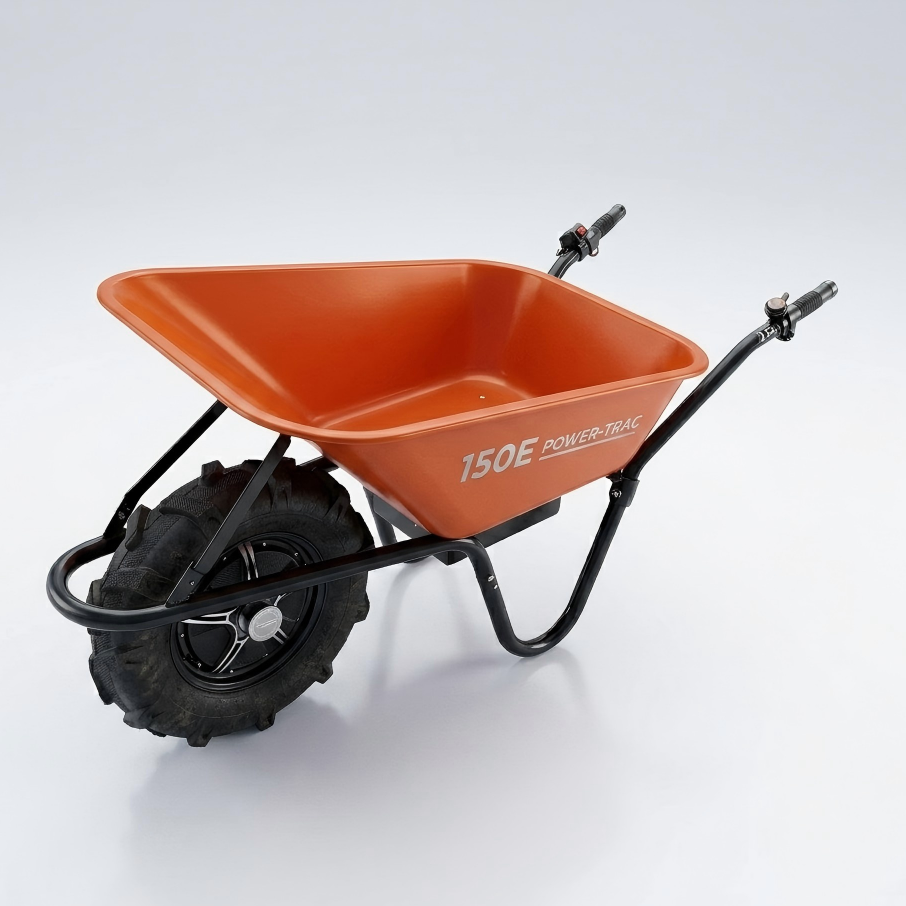
In the commercial landscaping and construction industries, labor is consistently one of the highest operating expenses. With wages rising across North America and Europe, business owners are forced to ask a critical question: How can we complete more projects in less time without increasing our headcount?
The answer lies in upgrading your basic fleet. While the traditional, manual wheelbarrow has been a job site staple for centuries, it is also a massive bottleneck for productivity.
In this guide, we will break down the hard mathematics of upgrading from manual hauling to an electric power wheelbarrow—such as the Outdoor Sunny QTP150E—and calculate the exact Return on Investment (ROI) for your business.
Introduction
Some people may think there is little difference between electric and manual wheelbarrows, and even regard electric models as pricey with limited efficiency. However, amid rising labor costs and heavier workloads, such comparisons have become increasingly essential.
Comparison
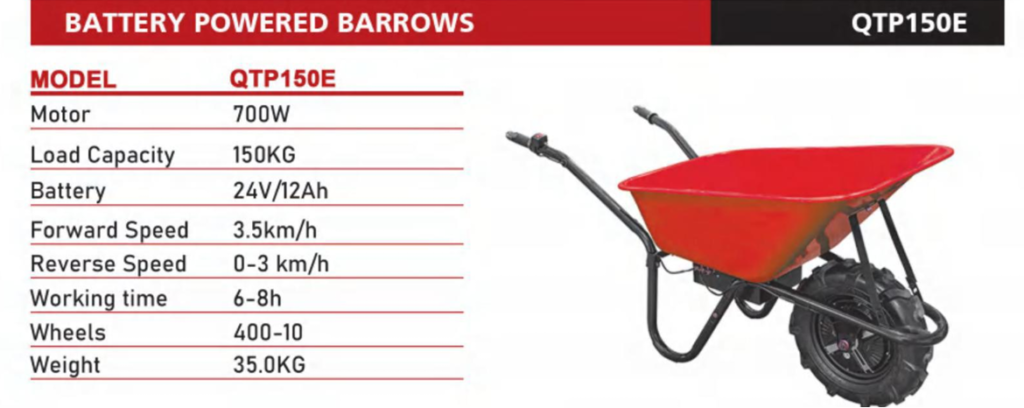
Take our QTP150E as an example. QTP150E hauls up to 150kg with its 700W motor, delivering reliable, zero-emission performance for 6–8 hours on a single charge.
The Real Cost of Manual Hauling
Manual wheelbarrows are cheap to buy, but incredibly expensive to operate. Consider the physical limits of a human laborer:
Fatigue-Induced Slowdown: A worker hauling wet soil, gravel, or bricks in a manual barrow moves quickly during the first hour. By hour four, their speed drops by up to 50\%.
Capacity Limitations: The average worker can safely balance and haul about 50 kg to 70 kg on rough terrain without risking tipping or injury.
Injury Risks: Back strains and muscle pulls from lifting and balancing single-wheel manual barrows are leading causes of worker compensation claims on landscaping sites.
Thanks to its 700W motor, 3.5km/h constant speed, and consistent 150kg load capacity without causing operator fatigue, the QTP150E boosts work efficiency to nearly 4 times that of traditional manual wheelbarrows.
As we all know, labor costs in Europe keep rising, with an average rate of €25 per hour across many countries. Let’s do a quick math example:
For a typical garden project, it would normally take 4 workers with manual wheelbarrows 4 hours to complete, costing the contractor €400 in total labor fees. With the QTP150E’s 4x efficiency, the same job can be done with just 1 worker in 4 hours – or the same team in far less time – saving at least €300 on labor. Even if the electric wheelbarrow costs about €150 more upfront than a manual model, you still walk away with a net savings of €150 right away.

Market Trends
Demand for electric wheelbarrows has surged since 2019. Its full electric drive fits well with current eco-friendly concepts, presenting a steady upward growth trend. Besides, simple operation and superior performance effectively reduce work-related injuries, safeguard workers’ safety and cut contractors’ occupational safety expenses.
Should you be interested or have any questions about our products, feel free to contact me anytime to get more details of QTP150E.
Conclusion: Work Smarter, Grow Faster
Continuing to rely on manual hauling in a competitive B2B market is a drain on your profits. By upgrading to commercial electric power wheelbarrows, you are not just buying a machine; you are buying back thousands of hours of high-priced labor and book